
Stop Networking. Start Reconnecting.
The network reactivation playbook

Inside this issue:
Why the people you rarely speak to are more valuable to your job search than the people you speak to every week
The medical devices VP who sent one short message and landed a role through Russell Reynolds 30 days later
🔒The exact reactivation prompt
Most executives spend their job search talking to the wrong people.
They call their close contacts. Their current network. People they see at every conference, people they message regularly, people who know their work well.
Those people will not find you your next role.
This is not an opinion. LinkedIn and MIT researchers ran an experiment across 20 million people and reversed 50 years of career advice.
Your close contacts operate in the same information ecosystem you do. They know what you know. They hear about the same roles you hear about. They move in the same industry circles.
Your distant contacts are different. They left your industry, moved to a new function, or built their career in a parallel world. When a role opens in their orbit, you are the last person they think of.
Unless you remind them you exist.
The Research Behind the Strategy
The study identified one specific type of contact that outperforms all others in job placement: the moderately weak tie.
Not your close friends. Not complete strangers. The people in between.
These contacts share 3 defining characteristics:
10 to 25 mutual LinkedIn connections
Not contacted in 12 or more months
Working in an adjacent function or industry
These are the people who can introduce you to opportunities you would never find on your own. Roles that have not been posted. Searches that have just been kicked off. A VP slot that a recruiter is quietly mapping the market for.
Warm introductions produce a 40 to 65% response rate. Cold applications produce 5 to 10%.
The math is not subtle.
The Case That Explains Everything
Last year, a VP of Marketing in medical devices was 3 months into her job search.
She had done what most executives do. Updated her resume. Applied to posted positions. Messaged a few recruiters she had worked with years ago.
Nothing was moving.
On a Sunday evening, she scrolled her LinkedIn connections and noticed an old colleague from a previous company. They had worked together briefly 8 years ago. He was now SVP at a top-10 medtech company.
She sent him a short message. No mention of her job search. No request for a favor. She referenced a product launch he had recently posted about and said it reminded her of a project they had worked on together.
He replied the next morning.
They had a 20-minute call. Somewhere in the conversation, she mentioned she was exploring what was next. He told her about a VP-level role his company was filling through Russell Reynolds. He offered to pass her name to the consultant.
She started her new job 30 days later.
She did not find that role on LinkedIn Jobs. She did not apply through a portal. She did not work with a resume writer.
One message to the right person changed everything.
Why Your Close Network Fails You
Your close contacts are your advocates. They believe in you. But advocacy is not the same as access.
The people you speak to every week are already in your world. They attend the same events. They follow the same companies. When a role opens, they hear about it at the same time you do, or after.
Your dormant contacts have moved into new ecosystems. A former colleague who joined a PE-backed startup 4 years ago now knows 200 people you have never met. A peer who moved into a different functional area is having conversations with headhunters in sectors you have not considered.
They are not more loyal to you. They are more useful to you. Because they have information you do not.
This is Granovetter’s weak ties theory, published in 1973 and validated at scale 50 years later. The research has not changed because human networks have not changed.
The 4-Step Reactivation System
Step 1: Filter Your LinkedIn Connections
Go to LinkedIn and filter your connections by people you have not messaged in 18 or more months. Target a list of 50 to 75 names. Focus on people who have changed roles, advanced in seniority, or moved into adjacent sectors.
Step 2: Research Before You Write
Spend 5 minutes on each contact before you message them. Look at their recent activity. A post they published, a promotion they announced, a company milestone they shared. You need a genuine, specific reason to reach out.
Generic reactivation messages get deleted. Specific ones get answered.
Step 3: Send a Non-Transactional Message
Do not mention your job search. Do not ask for introductions. Do not attach your resume.
Reference something real. Tie it back to shared history. Keep it under 4 sentences.
Use the prompt below to generate the messages that work.
Here is an example it created:
"Thomas, we debated market access strategy on that DACH panel in Vienna back in 2022—you made a compelling case for the specialist model. Saw your move to Siemens Healthineers. I have been exploring some new directions myself and finding myself circling back to conversations with people whose thinking shaped mine. Would be genuinely curious where you have landed on those questions now."
That is the whole message. No ask. No agenda.
The goal is a reply, not a favor.
Step 4: Reactivate Ten Contacts Per Week
520 contacts per year. 30 minutes of work per week. One of them knows about a role you will never find through a job board.
This is not a numbers game. It is a consistency game. You are not looking for 520 roles. You are looking for 1 or 2 conversations that change the trajectory of your search.
The Exact Reactivation Prompt
Below is the prompt I give my coaching clients. It generates a personalized, non-transactional reactivation message for any dormant contact in under 60 seconds.
You give it the contact’s name, your shared history, and one recent piece of their content. It writes the message. You review, adjust, and send.
I built 40 AI prompts over the past year.
Each one solves a specific problem in your executive job search.
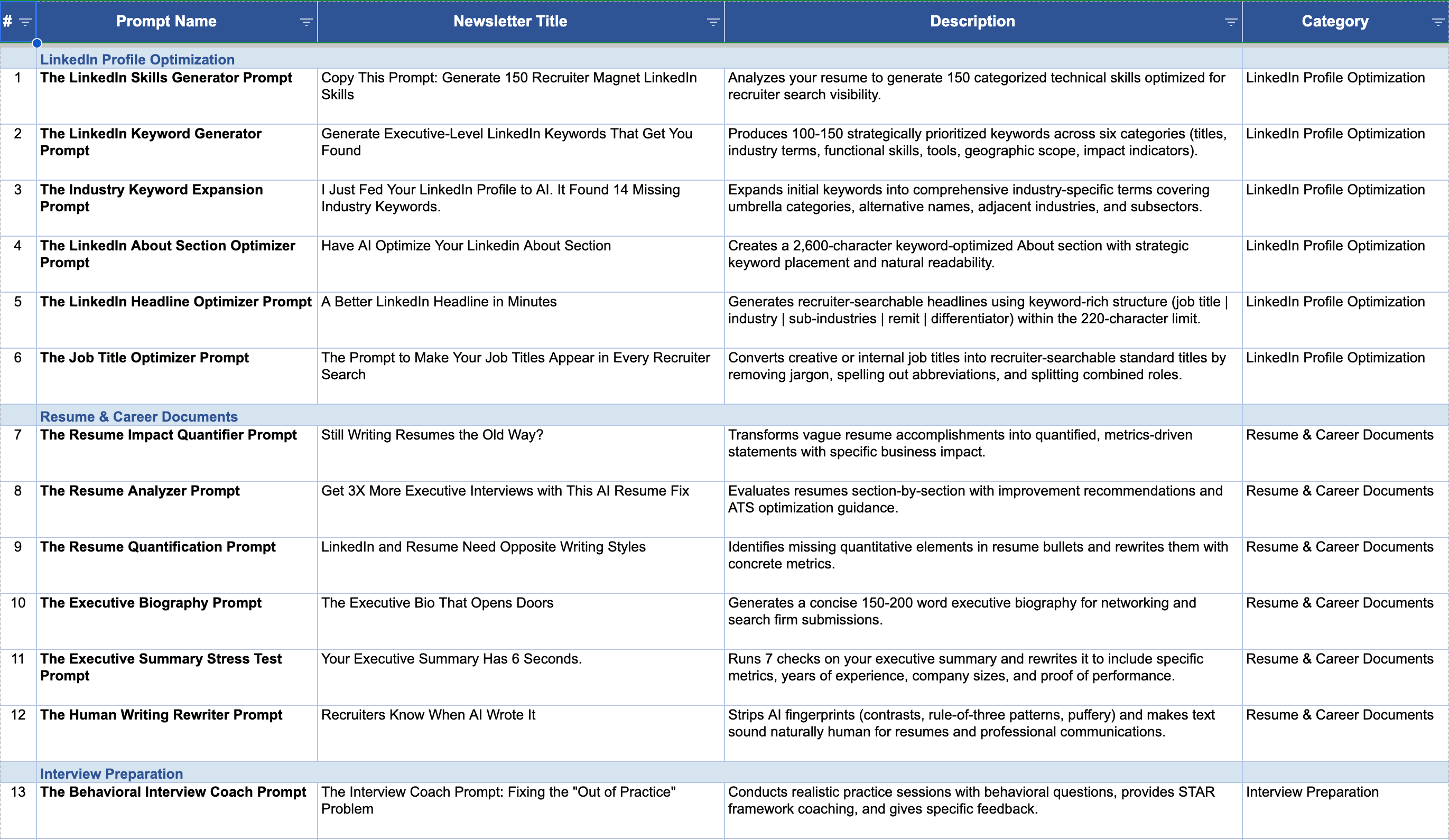
All copy-paste ready. All recruiter-tested.
Upgrade to paid and get access to all prompts the moment you join.
